
Bourdieu, Networks and Movement

A Study of Gender Differences in Undergraduate Physics

Bourdieu

Pierre Bourdieu - photograph by Leonardo Antoniadis

  • French Sociologist active around 1960 - 1990
  • Interested in the systems of relations that define society, and how this relates to the distribution of power.
  • Daisy

    My dog Daisy pie enjoying the comforts of Bourdieu's seminal work "Distinction - A Social Critique of the Judgement of Taste. Given Daisy's French ancestry, this photo is probably the most bourgeois photo in my possession.
    Three Key Concepts:

      Field (a section of society)

    • The social world is comprised of many different fields
    • Each field is hierarchical
    • Capital

    • Economic
    • Social
    • Cultural
    • Symbolic
    • Habitus

    • ``a system of dispositions'' (Bourdieu, 1984)
    • A ``generative schema'' (Nash, 1999)
    • Our internalisation of society

    • Influences what we 'like' or 'dislike'
    • Constantly subject to change

    The Current Study

  • Student data from the UoA physics department.
  • - N >9,000 (2009-15)

    - Must have taken at least one physics course to be included in our dataset.

    - Interested in gender differences in physics outcomes.

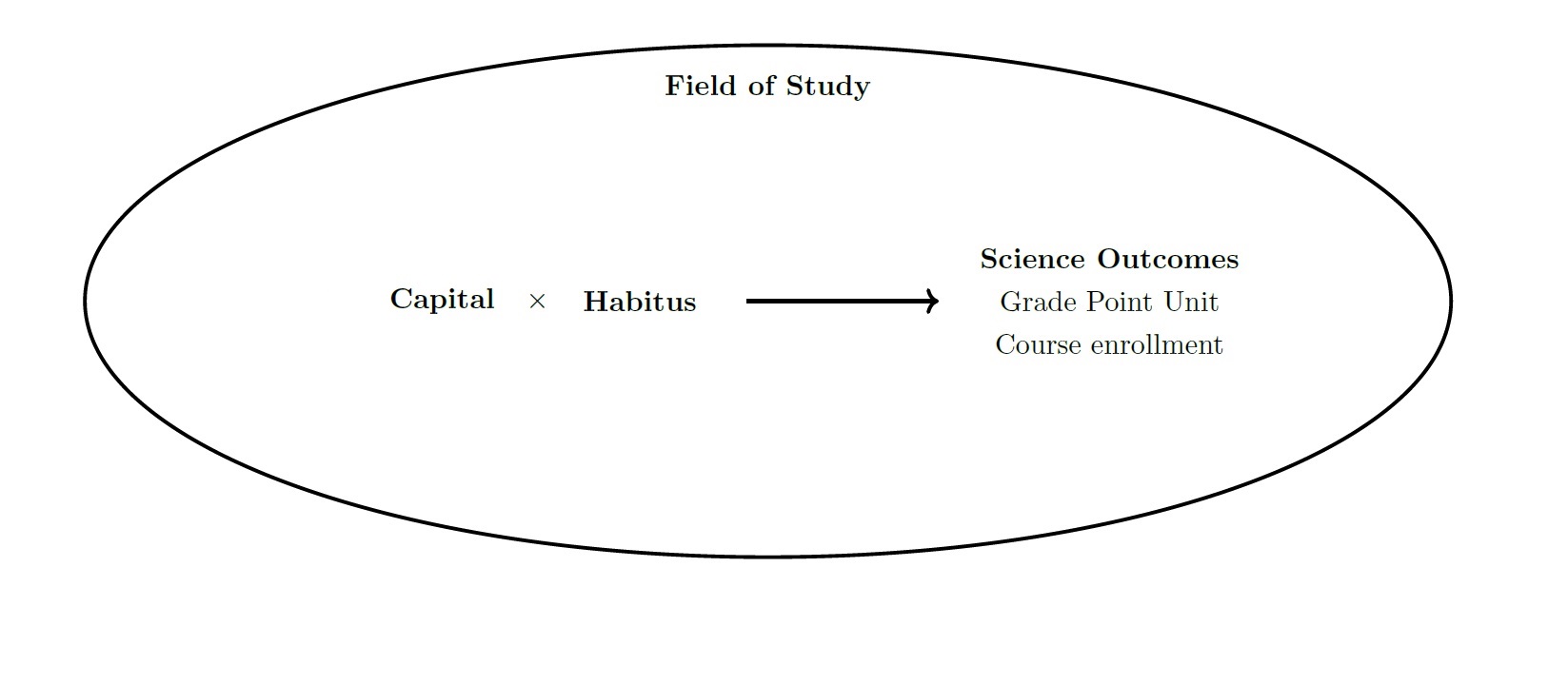
    Bourdieu's Theortical Model (Simplified)

    Bourdieu Theoretical Model

    Comparing tranverse/vertical movements between female and male students

  • Transverse Movements = changing from one field to another.
  • Vertical Movements = moving upwards/downwards in the 'rankings' of the field.
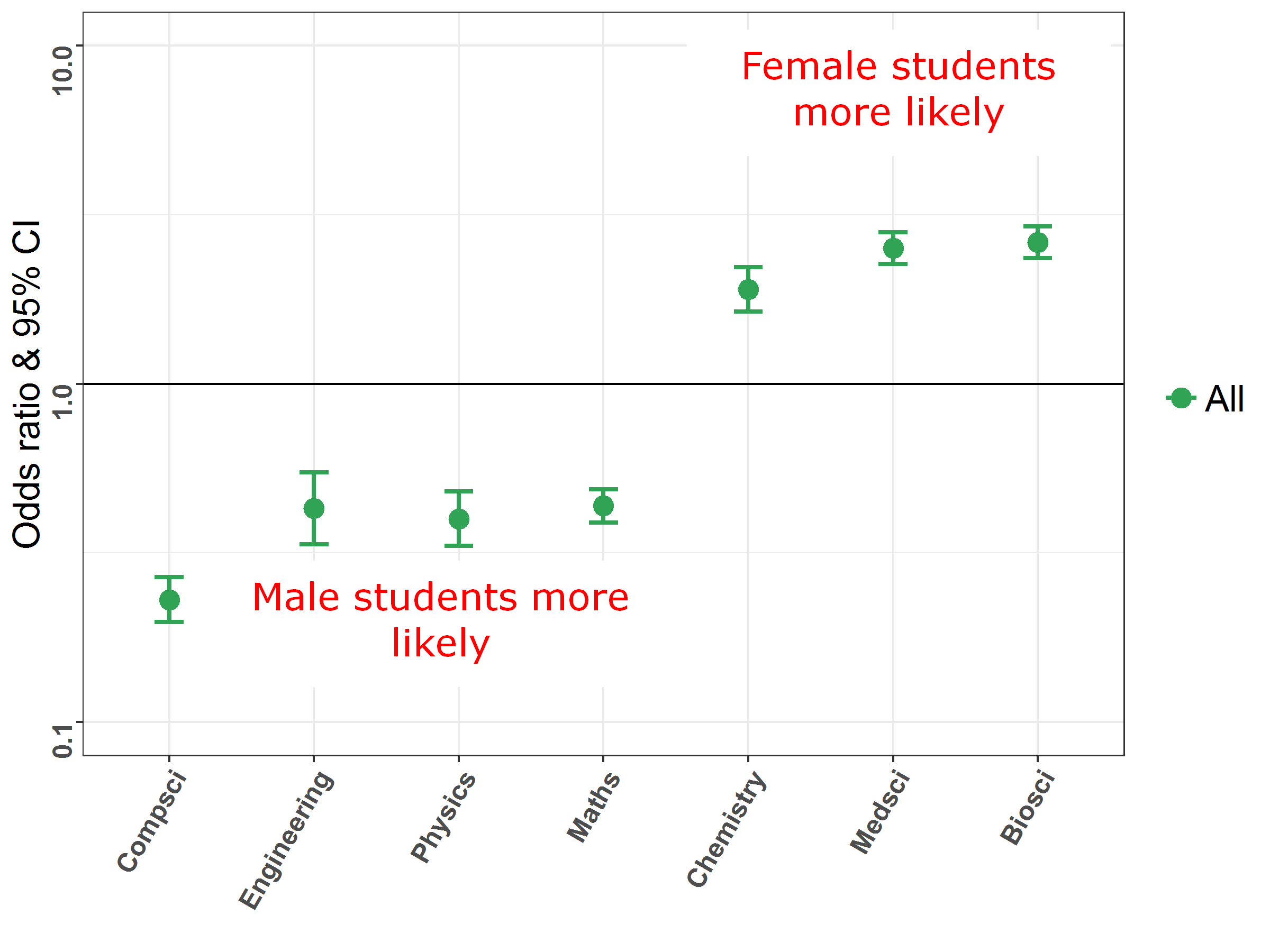
  • Transverse Movements

    OddsRatio

  • Female students more likely to take life sciences after first year physics
  • Male students more likely to study physical sciences
  • Original study intention is important.

    - Advancing Physics (Physics majors) vs Physics for Life Sciences (Med majors)

  • Vertical Movements

  • Movements upwards require an increase in the prized capital in the field

  • Movements downwards indicate relatively lower volume of capital

  • Below shows the movements based on volume of educational capital in physics


  • Seeing Trends in the Big Picture

    Habitus

    What is a realistic study option for me?

    What do people like me study?

    What do I enjoy?


    Many of the obstacles present in physics, are not as great in the life sciences

  • Negative gender stereotypes (Marchand & Taasoobshirazi, 2013)
  • Chilly climate (Barthelemy, McCormick & Henderson, 2016)
  • Lack of career enhancing resources/capital (Ivie, Tesfaye, Czujko & Chu, 2013)
  • Habitus * Capital = Science Outcomes

    Conclusion

    • Capital, Habitus and Field
    • Combining Student Data with Bourdieu
    • Transverse and Vertical Movements
    TPM

    Presentation available here:

    https://stur600.github.io/BourdieuNetworks/


    Email: s.turnbull@auckland.ac.nz

    Twitter: @Turdbull